Skip to content
+880-1618654728 info@aqiu-edu.com
Registrar Login
AGRI QUEEN INTERNATIONAL UNIVERSITY

AGRI QUEEN INTERNATIONAL UNIVERSITY

  • Home
  • About Us
    • Mission & Vision
    • The Founder & President
    • Chancellor 
    • Vice-Chancellor
    • History of AQIU
    • Chairman
    • Board of Member
    • Honorary Member
  • Administration
    • Treasurer
    • Registrar
    • Syndicate
    • Academic Council
    • Proctor
    • Controller
  • Offices
    • Dean’s Office
    • Office of the Director
    • Office of the Finance and Accounts
    • Office of the External Affairs
    • Office of the ICT Cell
    • Office of the Developments and Works
    • Office of the Transport
  • Academic
    • Faculty
      • Faculty of Health and Life Science
      • Faculty of Arts & Social Science
      • Faculty of Business and Entrepreneurship (FBE)
      • Faculty of Engineering
      • Faculty of Fine Arts
  • Facilities
    • Scholarship
    • Journal and Publication
    • Virtual Classroom
    • Central Library
    • UGC
    • IQAC
    • NOC
    • Webmail
  • People
  • Admission
    • Academic Advisor
    • Undergraduate Admission
    • Academic Rules and Regulations
  • Institutes & Centers
    • Stephen Maxwell Science Academy
    • Graduation Center
    • Language Center
    • Cultural Center
    • BCFRC CENTER
    • CBEES CENTER
    • Medical Center
    • Business Center
    • Consultant Center
  • NEWS AQIU
  • Career
    • PDCC
    • Jobs
    • Club
    • Hub
  • Notice
  • Contact us
xClose Menu

Potential Toxic Elements (PTEs) Research in Sediment by Dr. Hossain LAB

  • By admin
  • 28 Feb, 2026
  • News
Home → News → Potential Toxic Elements (PTEs) Research in Sediment by Dr. Hossain LAB

Potential Toxic Elements (PTEs) Research in Sediment by Dr. Hossain LAB

In sediment studies, monitoring PTEs is crucial because they can accumulate and persist in the environment, entering the food chain and affecting human health and ecosystems. Elevated levels of PTEs in sediments may lead to toxic effects on aquatic life and pose health risks to humans through exposure pathways like ingestion, inhalation, and dermal contact.

Dr. Md Muzammel Hossain conducted a comprehensive study entitled “Distribution of Potentially Toxic Elements in Sediments of the Municipal River Channel (Balu), Dhaka, Bangladesh: Ecological and Health Risks Assessment.” that is published on Journal of Contaminant Hydrology. This research investigates the presence and concentration of toxic elements in river sediments, evaluates their ecological impacts, and assesses potential health risks to local populations. The findings provide valuable insights into environmental pollution levels and help inform mitigation strategies to protect both ecosystems and public health in the Dhaka region.
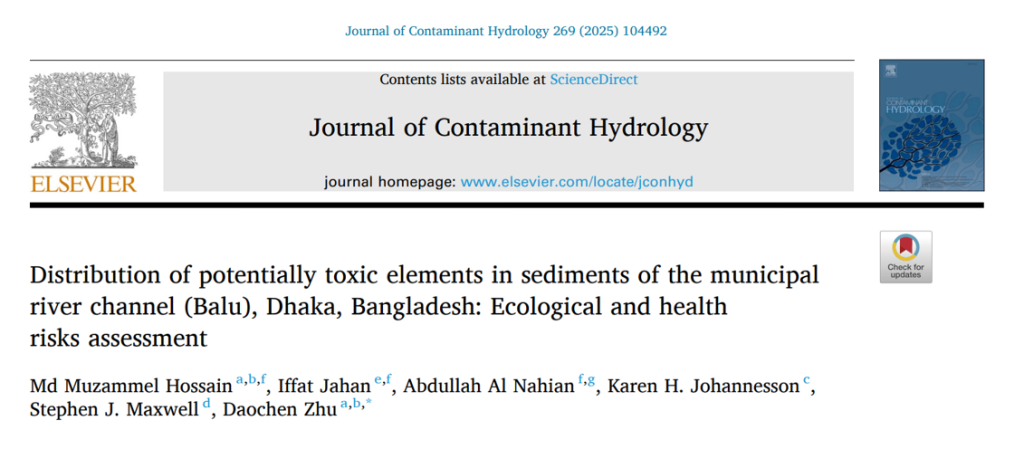
In Dr. Md Muzammel Hossain’s study focused on the human health risk assessment of the Potentially Toxic Elements (PTEs) from the sediments of the Balu River in Dhaka, Bangladesh. The study evaluated how these elements could pose health risks to local populations through various exposure pathways such as ingestion of sediment particles, dermal contact, and inhalation of dust.

The findings indicated that certain PTEs, depending on their concentrations and bioavailability, may pose significant non-carcinogenic and carcinogenic health risks, especially for vulnerable groups like children and residents who frequently come into contact with the river sediments. The assessment highlighted the necessity for monitoring and managing sediment contamination to reduce potential health hazards.

Principal Investigator of Dr. Hossain LAB is seeking research funding to continue and expand his investigation into the distribution and ecological and health risks of potentially toxic elements in sediments of the Balu River, Dhaka, Bangladesh. Securing this funding will enable him to conduct more comprehensive analyses, develop mitigation strategies, and contribute valuable data for environmental management and public health protection in the region.

Post navigation

  • Leave a Reply Cancel reply

    Your email address will not be published. Required fields are marked *

Related Posts:-

World Bee Day 2026

Irish researchers are harnessing the power of the ocean to promote a cleaner, greener

World Fish Migration Day 2026 Bangladesh

AQIU
About Us

Agri Queen International University (AQIU) is a  Private University in Bangladesh. It provides online and offline base high-quality education and promotes research to prepare students with the skills  necessary  for both national and international advancement. Distance base innovation through talent, excellence and responsibility.

Campus Site
  • Home
  • Offices
  • Facilities
  • Admission
  • Faculty
  • Scholarship
  • Mission & Vision
  • UGC
  • IQAC
  • Contact us
Calendar
May 2026
M T W T F S S
 123
45678910
11121314151617
18192021222324
25262728293031
« Apr    
Mailing Address

House No. 61/4 , Power House Road,    Word no 20, Kewatkhali, Mymensingh Sadar, Mymensingh, 2201, Bangladesh

Email: registrar@aqiu-edu.com

Tel: +880-1683739497,                          +880-1618654728

Recent News
  • Happy Eid-ul-Adha
  • World Fish Migration Day 2026
  • World Bee Day 2026

Copyright © 2026 Agri Queen International University, ICT Cell | Powered by WordPress.org